The decision on whether to get Invisalign or go for the conventional option is among the most frequent queries made by people with crooked teeth who wish to have a perfect smile. There is much that goes into either treatment choice. This article will help you determine whetherInvisalign vs Traditional Braces are the right choice for achieving your ideal smile.
Understanding the Basics: How Each Treatment Works
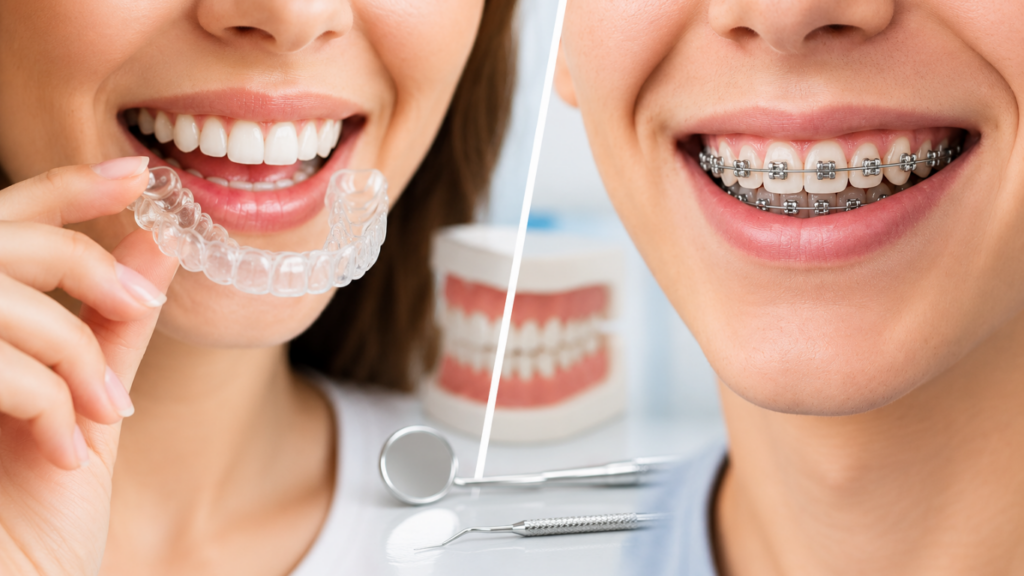
Before making a comparison, it makes sense to take a look at both options to fully grasp what it is that they each entail. Mechanism, materials, and everyday experience can differ greatly, and that makes all the difference when trying to determine which one is going to suit each individual best.
What Are Traditional Braces?
Traditional metal braces have long been considered the pinnacle of orthodontic treatments, and with good reason. These braces involve metal brackets attached to the teeth’s surface and connected by metal wires, which the orthodontist will adjust regularly to apply gentle but constant pressure, moving the teeth to their optimal position. Newer technology means today’s metal braces are much more comfortable than ever before, and for those who require extensive correction, there is still nothing better out there.
Apart from conventional metal braces, ceramic braces constitute an aesthetically advanced option that utilizes tooth-coloured or invisible brackets in place of the metallic ones. These braces provide the same mechanical function while appearing much more natural and discrete than their predecessors. Lingual braces are yet another kind of dental braces that go on the inner surfaces of the teeth but are less popular owing to their costliness and the time it takes patients to adapt to them with respect to speaking.
What Is Invisalign?
Invisalign is a particular brand of clear aligner therapy based on a set of removable plastic aligners designed to straighten your teeth gradually. Every aligner is worn by patients for a period of approximately one to two weeks after which another aligner is put on. The whole process is digitally planned with 3D digital scanning technologies which makes it possible for patients to have a look at their projected outcome prior to starting the treatment. The clear aligners are made of smooth medical grade plastic making them nearly invisible on the teeth.
It should be pointed out that although Invisalign is one of the best-known aligners out there, there are other clear aligner systems as well. At Baldivis Dental Clinic, we evaluate our patients’ individual needs and prescribe the aligner that works best for them.
Comfort and Day-to-Day Living
In many cases, comfort and ease of use become priorities on par with clinical efficacy. After all, you’ll be wearing one or the other for months, maybe even years. This is what daily life is like with each of the options described above.
Living with Invisalign
Patients who undergo Invisalign treatment find it comfortable after the initial adjustment period. The trays are perfectly smoothed and contoured to fit snugly around your teeth without sharp corners or exposed metal wires. Once you place a new pair of aligners, it will take some time for you to adjust – and again, the slight amount of pain or discomfort means that everything is working exactly as it should. There are no dietary restrictions with Invisalign as well – as long as you remove your aligners before eating, nothing stands in your way. Hygiene is also easy to maintain since brushing your teeth is not an issue at all.
The biggest challenge that comes with wearing Invisalign is compliance. The aligners should be worn for about 20 to 22 hours each day to get the best possible results in the expected time frame. Failure to replace your aligners after eating, or removing them when meeting up with friends, means that the entire treatment will take more time. We make this clear to our patients from the onset of consultations.
Advantages
- Almost invisible, perfect for adults and professionals
- Can be removed for meals and cleaning
- No food restrictions
- Smaller and more comfortable
- Less frequent emergency appointments due to broken brackets
- Virtual consultation of final result
- Shorter treatment period for mild cases
Disadvantages
- High level of 20-22 hours/day dedication needed
- Less successful in treating extreme/complex conditions
- More expensive than metal braces
- They may get lost/broken
- Have to remove them before eating/drinking something other than water
- Not suitable for some kinds of bite problems
Life with Traditional Braces
The first week of living with traditional braces tends to be the most difficult. The mouth will have to get used to the brackets, which can irritate the inner sides of the cheeks until they develop some hardness. Should you feel any pain, you can apply dental wax on the sharp parts. You will be experiencing discomfort after every tightening, which usually takes place after two to three days.
It is essential to maintain strict oral hygiene when wearing traditional braces. This is because the food will be stuck around the brackets. Additionally, you will need a floss threader or an interdental brush to properly floss between the braces and wire. Not adhering to oral hygiene will expose you to developing white spot lesions once the braces are taken off.
Advantages
- Extremely effective regardless of the level of misalignment
- No patient cooperation required
- Ideal for difficult bite alignment cases
- Usually cheaper to purchase initially
- Can never be misplaced
- Aesthetic benefits from ceramics
Disadvantages
- Obvious metal brackets
- Restricted diet during treatment
- May lead to sores or mouth irritation
- Difficult to maintain oral hygiene
- Increased number of dental appointments required
- Possibility of developing white spots due to inadequate oral hygiene
Effects of Treatment: Is It Possible for Them to Provide Equal Effectiveness?
In most cases, Invisalign aligners and traditional braces have proved to be equally effective treatment options for individuals suffering from only mild to moderate alignment problems. The end result will depend not on what option is selected, but rather on the professional skills of the dentist, the degree of cooperation and responsibility of the patient, and their consistent usage of retainers after the procedure.
When Traditional Braces Are Preferred
Traditional braces are currently the treatment of choice for individuals who suffer from severely crowded teeth, bite discrepancies (deep overbite, underbite, or crossbite), or those requiring complicated rotations and/or vertical movements of their teeth. While Invisalign has come a long way since its inception and is able to provide treatment even for conditions it initially couldn’t handle, there are still some cases in which traditional braces should be utilized.
Role of Retainers
No matter what treatment choice you make, the need for retainers after the end of your orthodontic treatment is mandatory. Your teeth tend to shift naturally into their pre-treatment positions especially during the first few months post treatment. There are two main types of retainers that you may be advised; either a removable one for nighttime wear or a fixed wire type bonded to the lingual surface of your teeth. Non-compliance to using retainers is the number one reason why patients experience regression of treatment results, which we go over in great detail with all our patients prior to completion of treatment.
Conclusion
Ultimately, deciding whether to go for Invisalign or braces comes down to personal preference, as well as dental needs, personal lifestyle, and financial considerations. While Invisalign provides a discreet, convenient, and efficient treatment method for those who are looking to improve their smile, traditional braces are still the benchmark when it comes to addressing more complicated problems in terms of orthodontics. Both forms of orthodontic treatment can be equally successful in achieving great results if they are conducted under the supervision of an expert.
Finding out which treatment would be the best one for you may prove to be quite difficult unless you undergo an evaluation by a professional orthodontist. At our Baldivis Dental Clinic, we will make sure that our experienced dentist conducts an examination of your teeth, discusses the results with you, and recommends an appropriate treatment plan that is right for you.